Pages

Ads 468x60px

Thursday, 23 June 2016

Passages of Gothic Project Notes

Following the intense and enjoyable screening of the Melodrama Research Group’s contribution to the International Festival of Projections,  here is a version of Frances’ wonderful Project Notes for Passages of Gothic.
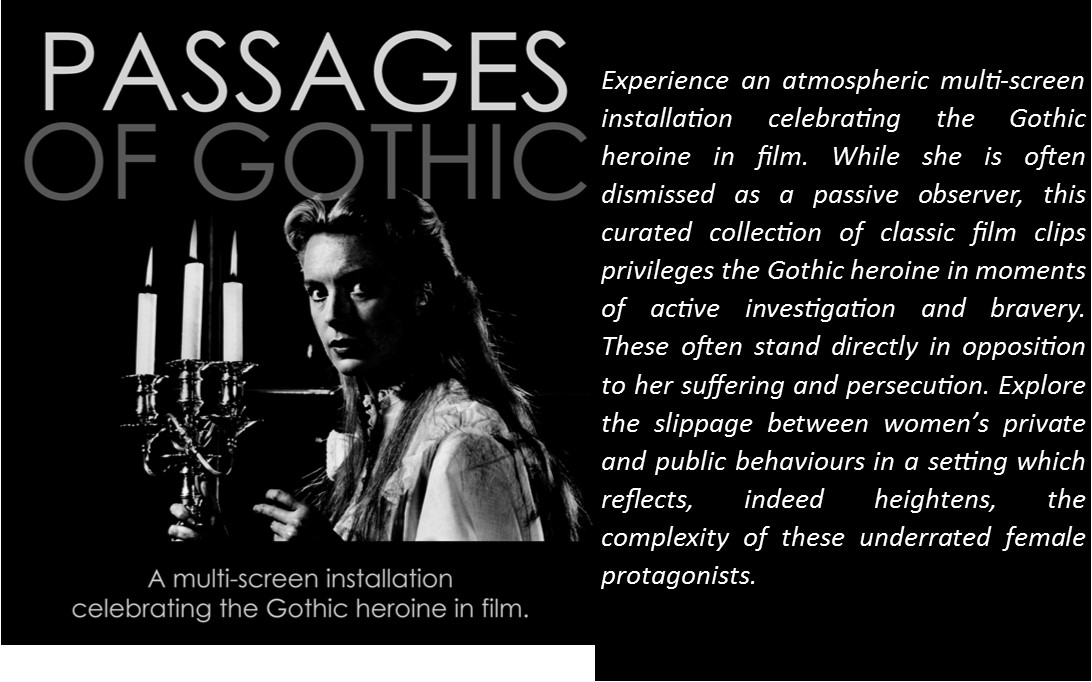
passages of gothic top

Alfred Hitchcock’s Rebecca (1940) is often cited as the first in a cycle of films emerging in Hollywood in the 1940s labelled as ‘Gothic’. These films – which have also been called ‘melodramas’, ‘women’s films’ and ‘female film noirs’ – feature similar narratives focusing on the central female protagonist: the Gothic heroine. In all these films, the Gothic heroine encounters the old dark house which harbours a sinister secret which the heroine must investigate, often in fear for her life. This threat usually emanates from a male love interest, or is sometimes presented as the oppression of a larger patriarchal society. These films – which also include Gaslight (1944), Secret Beyond the Door (1947) and Sleep, My Love(1948) – feature remarkably consistent motifs, including keys, staircases, images of the heroine alone in the dark and the threat of the domestic space. Significantly, the study of film history reveals that these tropes are not isolated to the Hollywood Gothics of the 1940s but, in fact, continue to inform and appear within the Gothic cinema of today. This installation shall highlight and explore these similarities.
This project focuses on the female performance in these films in order to show the narrative and visual agency given to characters who are often seen as passive subjects and victims. Whilst the Gothic heroine may indeed be threatened by her male counterpart or dangerous environment, these stories encourage us to identify with the female lead, admiring her bravery. We engage with these films’ narratives by aligning with the Gothic heroine and her experiences. In particular, our exploration of space is mediated by the Gothic heroine’s actions. This project will illuminate how such investigation consistently takes place within the domestic space: the safety of a home is transformed into the mysterious and dangerous space of the old dark house. Comparing these films demonstrates how the Gothic heroine is often framed within the in-between places of a house: the stairwell, the hallway or the doorway. These thresholds are spaces which blur the boundaries between the public and private spheres of a home, in much the same way these Gothic narratives present a slippage between the real and the imagined; the everyday and the supernatural.
It is for these reasons that Passages of Gothic is presented within Eliot Dining Hall. Eliot College is a building which is also both a public and private space, containing professional forums for study (lecture halls, seminar rooms and offices) and private rooms (student bedrooms and kitchens). The Hall is at the heart of the college and provides passageways between these distinct locations. The Hall’s distinctive appearance has also historically made it the site for public and private events, and its scale is evocative of the intimating houses the Gothic heroine explores in these films. As the name of this event suggests,Passages of Gothic therefore invites you to immerse yourself into the Gothic heroine’s world.
The film shall play on three separate screens and is divided into six ‘chapters’. Together, these chapters create a narrative which is reflective of the fictional journey taken by the Gothic heroine: the heroine enters the house; she is forced the investigate strange occurrences; she is threatened by someone or something; and she may or may not survive her ordeal. In Passages of Gothic these six chapters are:
  1. “I dreamt I went to Manderley again”: Gothic introductions
  2. Inside the house
  3. “I should go mad if I stay!”
  4. Lights in the darkness
  5. Women in peril
  6. “Why?”
Passages of Gothic is the culmination of the research conducted by the Melodrama Research Group into female performance, stardom, genre conventions, Gothic tropes and the representations of the heroine on-screen. This installation showcases the re-emergence of Gothic tropes – in a remarkably consistent fashion – across film history, highlighting the importance of the Gothic heroine within this. Our celebration of the Gothic’s strong, brave, and active heroines contributes to an important, broader research question: why, after 75 years, do these representations of the Gothic heroine persist in the 21st Century?
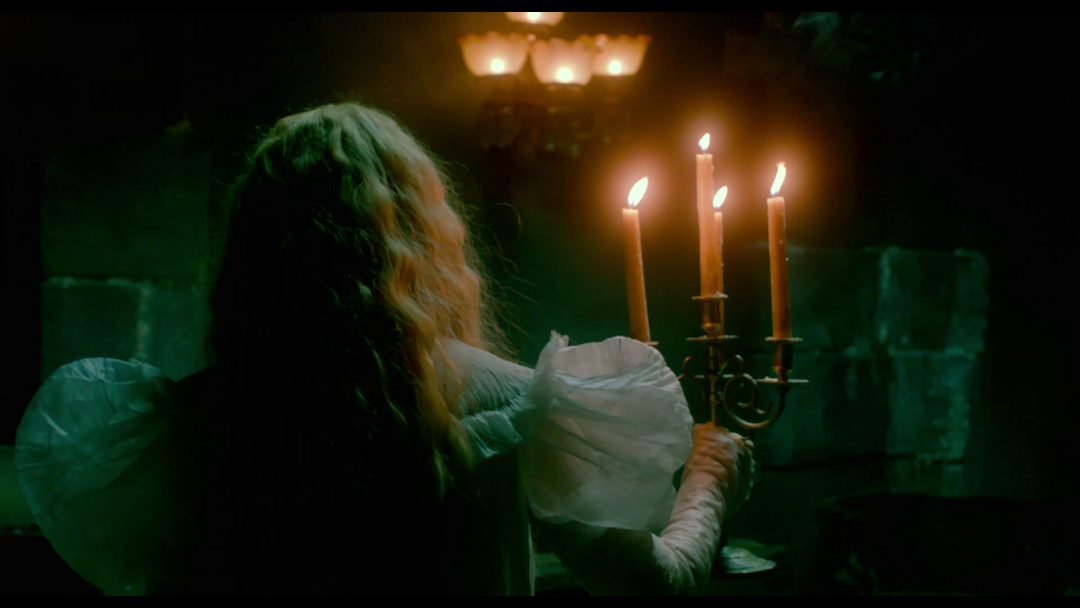
crimson peak
Top image: Lies Lanckman and Ann-Marie Fleming (image from The Innocents (1961); Main text: Frances Kamm; Bottom image: Crimson Peak (2015)
Credits:
Passages of Gothic
Project organiser: Sarah Polley
Project’s writer and content provider: Frances Kamm
Project’s editor: Alaina Piro Schempp
Lead technician: Lies Lanckman
Promotions: Ann-Marie Fleming
IT Support: Oana Maria Mazilu
Contributor: Tamar Jeffers McDonald
Contributor: Katerina Flint-Nicol

The Gothic Heroines
Joan Fontaine in Rebecca (1940)
Ingrid Bergman in Gaslight (1944)
Dorothy McGuire in The Spiral Staircase (1945)
Joan Bennett in Secret Beyond the Door (1947)
Claudette Colbert in Sleep, My Love (1948)
Deborah Kerr in The Innocents (1961)
Katharine Ross in The Stepford Wives (1975)
Shelley Duvall in The Shining (1980)
JoBeth Williams in Poltergeist (1982)
Sigourney Weaver in Aliens (1986)
Michelle Pfeiffer in What Lies Beneath (2000)
Nicole Kidman in The Others (2001)
Naomi Watts and Laura Harring in Mulholland Drive (2001)
Belén Rueda in The Orphanage (El Orfanato) (2007)
Rebecca Hall in The Awakening (2011)
Chiara D’Anna and Sidse Babett Knudsen in The Duke of Burgundy (2014)
Mia Wasikowska in Crimson Peak (2015)
The Melodrama Research Group is sponsored by the Centre for Film and Media Research within the School of Arts, University of Kent. The MRG is a cross-faculty group of academics who are interested in exploring the ideas surrounding melodrama as a hotly-contested topic. The group meets for regular screenings and debates, maintains a dynamic blog and has hosted research events. The group brings together scholars from various disciplines in order to foster collaborative networks for studying this pervasive but challenging genre.
This is a new, free arts festival taking place at the University of Kent from 18-20 March 2016. Spread across both the Canterbury and Medway campus, and with satellite events within the Canterbury City Centre, the festival celebrates the exciting and varied theme of projections.

It Happened One Night, 80 Years Ago

2014 has brought about the 75th anniversary of Gone with the Wind, which has been met with much deserving fanfare. No doubt, Rhett Butler is who draws the majority of people into Clark Gable fandom these days.
But this year brings about another important film milestone: the 80th anniversary of It Happened One Night, the little-film-that-could, one of the greatest romantic comedies ever made and the first to win the Academy Award “grand slam”: Best Picture, Best Director, Best Actor, Best Actress and Best Screenplay.  It is safe to say that if Clark had never played Rhett Butler, he would be remembered best for Peter Warne.
clark gable claudette colbert it happened one nightclark gable claudette colbert it happened one night
Director Frank Capra, one of the most renowned directors in the history of cinema, stated once that “a film about the making of It Happened One Night would have been much funnier than the picture itself.” I don’t know about that, but it sure would make a funny satire about movie making.
It Happened One Night started out as a magazine short story called “Night Bus” that was bought by the lowly, “poverty row” Columbia Pictures for a mere $5,000.  Capra, not yet at the top of his game and known mostly at that time for  the pre-code dramas he made starring Barbara Stanwyck, was not pleased about being assigned to direct this little bus film and argued with studio head Harry Cohn about it. He went off to Palm Springs with screenwriter Robert Riskin to try and squeeze some magic out of a tired old bus story.
clark gable claudette colbert it happened one night
Columbia didn’t have the payroll to house big names, so they always struck deals with other studios to get stars in their pictures. Capra and Cohn were excited to get some of MGM’s roster to be in their little bus picture. One of the first to turn down the script was Myrna Loy who recalled later, “Oh, I’ve taken flak for refusing that picture. Frank gave it to me for years…But let me say, here and now, they sent me the worst script ever, completely different from the one they shot. I’ve had others corroborate that… That girl was unplayable as originally written. I mean, we’re in the middle of the Great Depression and she’s running away because being rich bores her.” Her refusal was followed quickly by Constance Bennett, Miriam Hopkins and Margaret Sullavan. At the same time, Columbia was also making Twentieth Century and for that they were borrowing a certain Miss Carole Lombard, so they struck a deal to borrow Claudette Colbert for “Night Bus” as well. She balked at first, as she was due for a lengthy vacation. They were only able to secure her by promising a $50,000 paycheck and a written promise that the film would be completed in under four weeks.
clark gable claudette colbert it happened one night
It’s been widely reported that Clark Gable was sent to Columbia to star in IHON as a punishment for sleeping around with Joan Crawford despite Louis B. Mayer’s objections, and for missing weeks of filming due to a severe blood infection and causing production delays on Dancing Lady. Some reports say that isn’t true, that it wasn’t a punishment, it was just a deal between MGM and Columbia. Either way, Clark wasn’t happy. Robert Montgomery had already been secured and the contracts were being drawn up when suddenly Mayer withdrew his offer of Montgomery and replaced it with Gable.
clark gable claudette colbert it happened one night
Capra was at first elated to being offered Clark to star in his little bus film. But after his first meeting with the MGM star, he rightfully soured on the idea of Clark as the leading man. Capra remembered vividly his first encounter with Clark:
My open doorway darkened; tall, square-shouldered Gable stood there swaying, hat rakishly tilted over his eyes. Evidently, he had stopped at every bar between MGM and Gower Street.
“Is thish Mishter Frank Capra’s office?”
“Yes, Mr. Gable. I’m Frank Capra. Come in, please, come in.”
“Gla-ad to meet cha. Likewise.” He headed for a kitchen chair and plopped himself on it. I held my breath. The chair groaned, but didn’t break. Oh, was he loaded!…He cleared his throat with a  disgusted belch. Then he focused on me.
“Well-l, what’s the poop, shkipper–besides me?” He was not only boiled, he was steamed.
“Well, Mr. Gable, I–”
“That son-of-a-bitch Mayer,” he cut in. “I always wanted to see Siberia, but damn me–I never thought it would smell like this. Blech-h-h!”
My insides were curdling. I picked up a script and riffled it. “Mr. Gable, you and I are supposed to make a picture out of this. Shall I tell you the story or would you rather read the script by yourself?”
“Buddy,” he said in his tough-guy drawl, “I don’t give a [expletive] what you do with it.”
There being no handy rebuttal to that conversation stopper, I mumbled something about my Siberia being MGM, tucked the script under his armpit and suggested he read it between drinks. He swayed to his feet, looked down at me, and giggled drunkenly, “Hee hee-e-e! Sez you.” He wobbled out the door, hit both sides of it, then stumbled off, singing, “They call her frivilous Sa-a-al, a peculiar kinf of a–hey, you guys!” this last came to some Colombians in the courtyard, “Why aren’t you wearing parkas in Siberia?”
That was my first meeting with Clark Gable and, I hoped, my last.
clark gable claudette colbert frank capra it happened one night
Not the best first impression, but Capra’s opinion of Clark changed after filming began. “Clark turned out to be the most wonderful egg. He just had a ball. What I believe is that he was playing himself, and maybe for the only time in his career. That clowning, boyish, roguish he-man was Gable. He was shy, but a lot of fun with people he knew. He was very sensitive about those God-damned ears, but he made jokes about them. After a shot, he’d ask, ‘What’d they get–an ear?’ He didn’t look like anyone else. It was not only physical; he had mannerisms that were all his own; ways of standing, smoking–things like that–and a great flair for clothes. Whatever came natural to him, I let him do.”
clark gable it happened one night
Despite it’s rough start, the set of the film turned out to be an easygoing one, with improvising encouraged.
clark gable claudette colbert frank capra it happened one night
The story is of  Peter Warne, a cocky newspaperman who has just been fired, encountering runaway heiress Ellie Andrews on a night bus to New York from Miami. Peter realizes her identity and befriends her so he can get the exclusive story. Along the way, after masquerading as man and wife at an auto camp, sleeping in a field, hitch hiking and stealing a car, they fall in love. When Peter leaves Ellie at a motel in the middle of the night to try and get some money from his old boss to marry her, she mistakenly thinks he has left her for good and calls her father (Walter Connolly) and husband to pick her up. Peter is heartbroken and so is Ellie. She agrees to her father’s wishes that she re-marry her husband, since they were not married by a priest. On her re-wedding day, Peter shows up to collect money from her father for what he spent on her during the trip. He admits to her father that he loves her. Her father tells Ellie and as she is going down the aisle, she takes off to be with Peter.
Gable is Peter Warne, a cocky newspaperman who has just been fired. On a bus to New York, he meets Ellie Andrews (Claudette Colbert), a runaway heiress, on her way to be reunited with her new husband whom her father detests. Peter soon realizes her identity and befriends her so he can get the exclusive story. Along the way, after masquerading as man and wife at an auto camp, sleeping in a field, hitch hiking and stealing a car, they fall in love. When Peter leaves Ellie at a motel in the middle of the night to try and get some money from his old boss to marry her, she mistakenly thinks he has left her for good and calls her father (Walter Connolly) and husband to pick her up. Peter is heartbroken and so is Ellie. She agrees to her father’s wishes that she re-marry her husband, since they were not married by a priest. On her re-wedding day, Peter shows up to collect money from her father for what he spent on her during the trip. He admits to her father that he loves her. Her father tells Ellie and as she is going down the aisle, she takes off to be with Peter.Gable is Peter Warne, a cocky newspaperman who has just been fired. On a bus to New York, he meets Ellie Andrews (Claudette Colbert), a runaway heiress, on her way to be reunited with her new husband whom her father detests. Peter soon realizes her identity and befriends her so he can get the exclusive story. Along the way, after masquerading as man and wife at an auto camp, sleeping in a field, hitch hiking and stealing a car, they fall in love. When Peter leaves Ellie at a motel in the middle of the night to try and get some money from his old boss to marry her, she mistakenly thinks he has left her for good and calls her father (Walter Connolly) and husband to pick her up. Peter is heartbroken and so is Ellie. She agrees to her father’s wishes that she re-marry her husband, since they were not married by a priest. On her re-wedding day, Peter shows up to collect money from her father for what he spent on her during the trip. He admits to her father that he loves her. Her father tells Ellie and as she is going down the aisle, she takes off to be with Peter.Gable is Peter Warne, a cocky newspaperman who has just been fired. On a bus to New York, he meets Ellie Andrews (Claudette Colbert), a runaway heiress, on her way to be reunited with her new husband whom her father detests. Peter soon realizes her identity and befriends her so he can get the exclusive story. Along the way, after masquerading as man and wife at an auto camp, sleeping in a field, hitch hiking and stealing a car, they fall in love. When Peter leaves Ellie at a motel in the middle of the night to try and get some money from his old boss to marry her, she mistakenly thinks he has left her for good and calls her father (Walter Connolly) and husband to pick her up. Peter is heartbroken and so is Ellie. She agrees to her father’s wishes that she re-marry her husband, since they were not married by a priest. On her re-wedding day, Peter shows up to collect money from her father for what he spent on her during the trip. He admits to her father that he loves her. Her father tells Ellie and as she is going down the aisle, she takes off to be with Peter.Gable is Peter Warne, a cocky newspaperman who has just been fired. On a bus to New York, he meets Ellie Andrews (Claudette Colbert), a runaway heiress, on her way to be reunited with her new husband whom her father detests. Peter soon realizes her identity and befriends her so he can get the exclusive story. Along the way, after masquerading as man and wife at an auto camp, sleeping in a field, hitch hiking and stealing a car, they fall in love. When Peter leaves Ellie at a motel in the middle of the night to try and get some money from his old boss to marry her, she mistakenly thinks he has left her for good and calls her father (Walter Connolly) and husband to pick her up. Peter is heartbroken and so is Ellie. She agrees to her father’s wishes that she re-marry her husband, since they were not married by a priest. On her re-wedding day, Peter shows up to collect money from her father for what he spent on her during the trip. He admits to her father that he loves her. Her father tells Ellie and as she is going down the aisle, she takes off to be with Peter.Gable is Peter Warne, a cocky newspaperman who has just been fired. On a bus to New York, he meets Ellie Andrews (Claudette Colbert), a runaway heiress, on her way to be reunited with her new husband whom her father detests. Peter soon realizes her identity and befriends her so he can get the exclusive story. Along the way, after masquerading as man and wife at an auto camp, sleeping in a field, hitch hiking and stealing a car, they fall in love. When Peter leaves Ellie at a motel in the middle of the night to try and get some money from his old boss to marry her, she mistakenly thinks he has left her for good and calls her father (Walter Connolly) and husband to pick her up. Peter is heartbroken and so is Ellie. She agrees to her father’s wishes that she re-marry her husband, since they were not married by a priest. On her re-wedding day, Peter shows up to collect money from her father for what he spent on her during the trip. He admits to her father that he loves her. Her father tells Ellie and as she is going down the aisle, she takes off to be with Peter.Gable is Peter Warne, a cocky newspaperman who has just been fired. On a bus to New York, he meets Ellie Andrews (Claudette Colbert), a runaway heiress, on her way to be reunited with her new husband whom her father detests. Peter soon realizes her identity and befriends her so he can get the exclusive story. Along the way, after masquerading as man and wife at an auto camp, sleeping in a field, hitch hiking and stealing a car, they fall in love. When Peter leaves Ellie at a motel in the middle of the night to try and get some money from his old boss to marry her, she mistakenly thinks he has left her for good and calls her father (Walter Connolly) and husband to pick her up. Peter is heartbroken and so is Ellie. She agrees to her father’s wishes that she re-marry her husband, since they were not married by a priest. On her re-wedding day, Peter shows up to collect money from her father for what he spent on her during the trip. He admits to her father that he loves her. Her father tells Ellie and as she is going down the aisle, she takes off to be with Peter.Gable is Peter Warne, a cocky newspaperman who has just been fired. On a bus to New York, he meets Ellie Andrews (Claudette Colbert), a runaway heiress, on her way to be reunited with her new husband whom her father detests. Peter soon realizes her identity and befriends her so he can get the exclusive story. Along the way, after masquerading as man and wife at an auto camp, sleeping in a field, hitch hiking and stealing a car, they fall in love. When Peter leaves Ellie at a motel in the middle of the night to try and get some money from his old boss to marry her, she mistakenly thinks he has left her for good and calls her father (Walter Connolly) and husband to pick her up. Peter is heartbroken and so is Ellie. She agrees to her father’s wishes that she re-marry her husband, since they were not married by a priest. On her re-wedding day, Peter shows up to collect money from her father for what he spent on her during the trip. He admits to her father that he loves her. Her father tells Ellie and as she is going down the aisle, she takes off to be with Peter.
There are so many great scenes, from the Walls of Jericho and “Perhaps you’re interested in how a man undresses.” to singing “The Flying Trapeze,” to hitch-hiking and a lesson in doughnut dunking, the film is no doubt a classic.
clark gable claudette colbert it happened one nightclark gable claudette colbert it happened one nightclark gable claudette colbert it happened one nightclark gable claudette colbert it happened one nightclark gable claudette colbert it happened one night
The film began shooting the last week of November and shot the last scene on December 23, 1933, costing a mere $325,000 to make. Claudette set out for vacation and Clark headed back to MGM, both certain that they’d just had a fun time making a sure flop. “Clark and I left wondering how the movie would be received. It was right in the middle of the Depression. People needed fantasy, they needed splendor and glamour, and Hollywood gave it to them. And here we were, looking a little seedy and riding on our bus.” Claudette recalled.
clark gable claudette colbert it happened one night
IHON  wasn’t an overnight sensation. It received good press reviews and the numbers were steady; but it was the word of mouth from moviegoers that brought in the receipts.  It ended up earning $1.1 million domestically, a large sum for a little bus picture made by a little studio.
Despite its success, it still was a shock that the film won all the major Academy Awards. Claudette famously had to accept her award in her traveling suit as she had been on her way to the train station when she heard she had won!
clark gable academy award oscar
The film changed Clark’s life for many reasons. The first being, of course, that is was his first Oscar nomination and only win; ultimately it was the only major film award he would ever win. Secondly, the film skyrocketed his popularity. Before this, he was steadily gaining fans, but was mostly used as a “gigolo” for MGM’s female stars, playing second fiddle to Jean Harlow, Norma Shearer and Joan Crawford. IHON showed he could hold his own. Third, it proved he had real star power–just by removing his shirt and showing he had no undershirt underneath, sales of undershirts sharply declined!
Lastly, this film holds a special place in my heart. Years ago, I was just dipping my toe into classic films. I was flipping through the channels and TCM was on commerical and it said IHON was next. I remembered reading that Clark Gable (who was little more to me at that point than Rhett Butler) had won an Oscar for it but other than that I knew nothing about it. Little did I know that the film I was about to watch not only became one of my favorite films of all time, but it can be credited with this website as if it wasn’t for Clark’s absolutely wonderful performance capturing my heart, I wouldn’t be the Gable fan I am today.


Blogger Templates